
THE METHOD
A SYSTEM FOR FAST BOWLING PERFORMANCE- BUILT FOR TRANSFER
Everything starts with profiling. From that profile we plan the intervention, organise the programme, and measure whether it transfers to ball speed, robustness and durability. We are powered by technology-led feedback loops - including Pitchwolf AI, Pocket Radar, 1080 Sprint, and Volt Athletics... tracking over 100 performance and durability metrics per athlete.
THE SYSTEM
WHAT IS THE PACELAB METHOD
The PaceLab Method is a profiling-led performance systems that identifies what limits a bowler's speed and durability. The targets that limiter through classified training, progressive bowling exposure, and constant feedback loops. We determine whether a bowler is hip or knee dominant, force or velocity limited, and how they respond to heavy vs light ball exposure. Every drill, lift, sprint, throw and bowling variation has a defined role, organised through a classification framework aligned with Bondarchuk principles. If a method doesn't transfer, it doesn't stay.
That's the difference between a programme and a system.
That's the difference between a programme and a system
This is a Paragraph Font
CORE PRINCIPLES
THE RULES OF ENGAGEMENT
These principles keep the method consistent across every athlete, phase, and programme.
PROFILE FIRST, INTERVENE SECOND
We identify the true limiter using archetype classification and force/load velocity profiles, then plan the intervention.
THE BOWLER IS A COMPLEX SYSTEM
Performance emerges from structure, mechanics, neurology, perception, and intent- coached as one interacting system.
MOTOR LEARNING DRIVES SKILL CHANGE
Representative tasks, constraints, intent and perception-action coupling... not forced technique.
CLASSIFICATION GIVES METHOD A PLACE
Nothing is random. Every method sits in a heirarchy with a defined purpose and expected transfer.
In this video, Steffan explains the relevance of the PaceLab training system and how it creates long lasting change in bowlers around the world.
HOW IT WORKS
A SIMPLE MODEL - EXECUTED WITH PRECISION
We reverse engineer the programme from when you need to peak. The goal is controlled peak points across the season... so we can verify the system is working and adjust early
PHASE TIMELINE
OFF SEASON (GENERAL PREP)
Build the capacities that set the ceiling: force production, elastic qualities, tissue tolerance, and stable skill attractors.
OFF SEASON (SPECIFIC PREP)
Shift qualities toward bowling-specific transfer: intent exposure, load-velocity targeting, sequencing, and high-speed outputs.
IN SEASON
Maintain and express outputs while managing workload, fatigue, and durability... keeping speed available under match demand.
WHAT WE PLAN
INTENT
Speed focused bowling to develop maximum output.
EXERTION
Workload blowing to build robustness and tolerance.
LOAD
Overload/underload bowling to shift force-velocity characteristics.
EXECUTION
Skill + accuracy so match performance emerges naturally.
TOLERATION CYCLES
HOW BOWLING VOLUME IS ORGANISED
Many bowlers are not only overcooked - many are undercooked. We manage both ends.
Factorisation (microdosing)
High frequency, low fatigue exposure; typically 5 days/week with strict drop-off control.
Frequency Cycle
Moderate exposure (2 sessions/week), tolerance building without excessive fatigue.
Fatigue Cycle
One high-stress exposure/week to challenge durability, then recover and adapt.
WHAT WE MEASURE
IF IT'S NOT MEASURED, IT'S GUESSED.
PaceLab is built on feedback loops. We track the outputs that matter, measure them consistently and use the data to decide what stays, what changes, and what the athlete needs next. Measurement is not a bonus feature... it's how we ensure training transfers to ball speed, robustness and execution.
Ball speed (primary outcome)
Ball speed is our primary indicator of progression and transfer, because it reflects neural output and whether training is actually raising an athlete’s ceiling. We measure it using consistent protocols with Pocket Radar at defined points across the plan and within key session types, tracking both peak speed and how repeatable that speed is under fatigue. If speed is not improving—or if it cannot be accessed reliably—the system is not transferring, and the intervention changes.

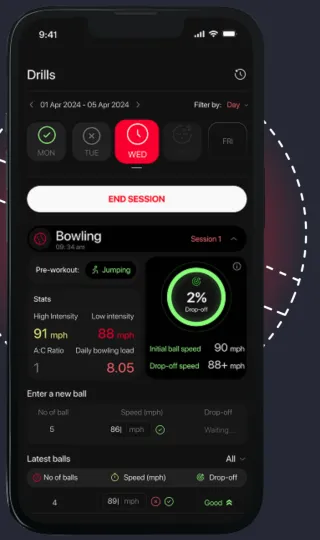
Workload and intensity (AREG)
We measure bowling stress, not just volume, because ball counts alone ignore the reality that intent, intensity, and implement weight massively change the load on the system. Workload is monitored through planned exposure types across the week and controlled using tolerance-based decision rules (including drop-off thresholds) so we can progress durability without suppressing speed. This is how we avoid both overcooking and undercooking—building bowlers who can handle the demands of fast bowling while keeping output available
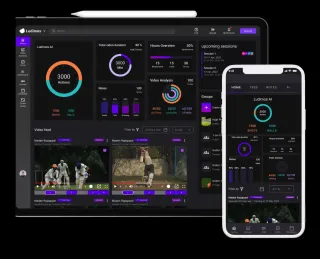
Kinematic and technical positions (Pitchwolf)
We quantify key technical positions and movement patterns because technique needs to be measured, not guessed, and any change must hold under speed and fatigue to be meaningful. Using Pitchwolf AI, supported by repeatable video capture, we track objective kinematic metrics across phases and compare them against performance outputs such as ball speed and execution quality. This prevents cosmetic coaching, allows us to verify what is working, and ties technical interventions directly to outcomes that matter.

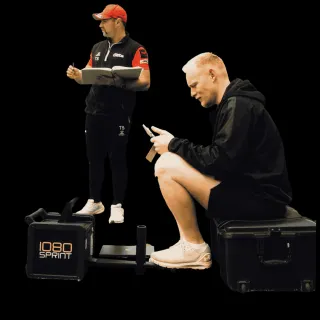
Force-velocity and load-velocity profiling (1080 Sprint)
We measure force–velocity and load–velocity characteristics to identify the true limiter—whether an athlete is force-limited, velocity-limited, or inefficient at converting force to speed—and to guide decisions around heavy-ball, light-ball, or blended exposure. Using 1080 Sprint profiling at consistent checkpoints, we can see exactly which quality needs to move and whether the athlete is adapting in the direction that should raise bowling output. This replaces generic programming with targeted intervention and dramatically increases the likelihood of real transfer to ball speed and robustness.
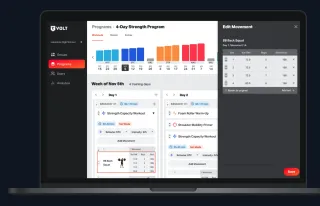
Strength and Elastic Markers
We track foundational strength and elastic qualities because they provide the capacity base that supports output, resilience, and repeatability across a season. Using simple, reliable strength and power markers repeated across the plan, we build context for why speed is moving or stalling and whether the athlete can tolerate the exposures required to get faster. These numbers are not treated in isolation; they are interpreted alongside speed, workload response, and kinematics so the programme develops the right engine—not just more training volume.
Execution quality under intent + fatigue
We measure execution quality—accuracy and dispersion under real intent—because performance is stable skill at high output, not slow practice that disappears under pressure. Execution tasks are embedded into sessions where intensity and fatigue are present, and we track whether outcomes remain stable as constraints increase, rather than relying on one-off target drills. This ensures that speed improvements convert into usable fast bowling performance, where the athlete can bowl fast and still hit the areas that win games.
Everything is measured. Everything has a purpose. If the numbers don't move, the plan changes.
WHO WE SERVE
THE METHOD STAYS THE SAME.
THE PATHWAY CHANGES.
Choose your role and we'll route you into the right way to engage with PaceLab
PLAYERS & PARENTS
A clear development pathway built around the individual bowler. Profiling, planning, and measurement that translates into speed, robustness, and execution.
START PLAYER PATHWAY
COACHES
Frameworks, education, and tools to coach fast bowling as a system. Improve decision-making, session design, and transfer- not just technical cues.
EXPLORE COACH SUPPORT
DECISION MAKERS
A scalable system for programmes , schools, and academies. Align staff, standardise profiling and planning, and prove outcomes with measurement.
PARTNER WITH PACELAB
Copyright 2026. PaceLab. Company Number GB11702887. VAT Registration GB449367454. All Rights Reserved.